


Tata Sierra EV vs Maruti Suzuki eVX/e-Vitara: India’s Upcoming EV Battle Explained
India’s electric vehicle (EV) market is entering one of its most competitive phases yet, with two major automakers—Tata Motors and Maruti Suzuki—preparing landmark EV launches in 2025–26. Tata’s revival of its iconic Sierra EV and Maruti’s first global EV, the eVX (expected to be branded as e-Vitara in India), are poised to compete directly in the compact and midsize electric SUV segment.
Both models aim to set new standards in design, range, features, and pricing while appealing to buyers transitioning from traditional petrol/diesel cars to modern electric alternatives. This report provides a neutral, detailed comparison across performance, design, technology, safety, pricing expectations, and market positioning.
Two EVs, One Highly Competitive Market

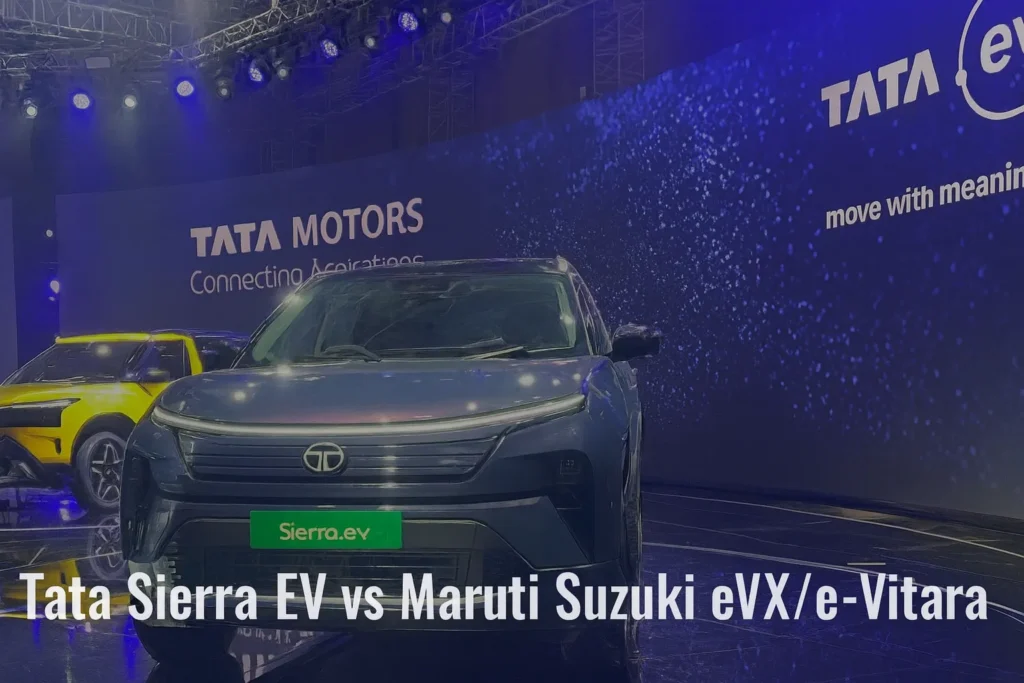
Tata Motors currently leads India’s EV market with products like the Nexon EV, Tiago EV and Punch EV. The introduction of the Sierra EV, a modern reinterpretation of a 1990s legend, marks a major step into premium EV territory.
Maruti Suzuki, India’s largest carmaker by volume, enters the EV race with a clean-sheet project: the eVX/e-Vitara, co-developed with Toyota and built on a global EV skateboard platform. Unlike Tata, which already has a presence in the EV space, Maruti aims to establish its first foothold with a future-ready SUV.
Both models were showcased at the Auto Expo and will be produced in India, with strong localisation to keep costs competitive.
Exterior Design: Retro Appeal vs Futuristic Minimalism
Tata Sierra EV
The Sierra EV stands out due to its iconic three-door-inspired silhouette revived from the original Sierra. It carries:
- A connected LED front light bar
- Squared wheel arches
- Rugged SUV-inspired stance
- Large panoramic “Sierra glass house” at the rear
- Chunky cladding and bold proportions
The design leans heavily into nostalgia while providing a modern electric interpretation.
Maruti eVX / e-Vitara
The eVX focuses on clean, sharp, futuristic lines, matching upcoming global EV trends. Expected highlights include:
- Y-shaped LED DRLs
- Minimalistic, crease-free surfaces
- Large wheel options up to 19 inches
- Wide LED tail-light signature
- Muscular stance similar to Creta-class SUVs
Unlike the Sierra’s retro aura, the eVX uses a global EV design language with aerodynamic efficiency in mind.
Verdict (Design)
- Sierra EV → More emotional, distinctive, retro-modern identity
- eVX/e-Vitara → Clean, futuristic global styling
Buyer choice will depend on whether they want bold nostalgia or sleek modernity.
Interior & Features: Premium Cabin Tech Showdown


Tata Sierra EV
Though the final production interior is yet to be fully unveiled, expectations based on Tata’s latest models include:
- A large twin-screen setup (instrument cluster + infotainment)
- Soft-touch materials with eco-friendly themes
- Ventilated seats
- Panoramic sunroof
- 360-degree camera
- Level 2 ADAS
- Wireless connectivity
The Sierra is expected to offer a lounge-like cabin with adjustable rear seats and a focus on comfort.
Maruti eVX / e-Vitara
Based on global previews, Maruti’s EV will feature:
- Dual-screen layout (likely 10.25-inch displays)
- Wireless charging
- Panoramic sunroof
- Premium upholstery
- Auto AC
- Level 2 ADAS
- Connected car technology
The interior of the eVX focuses more on practicality and clean design rather than a theme-driven space like Sierra.
Verdict (Interior & Features)
Both SUVs appear closely matched. Sierra may have more premium elements, while Maruti offers minimalistic global styling.
Battery, Range & Performance
Tata Sierra EV (Expected Specifications)
Tata has not released detailed specs, but based on the company’s Gen 2 EV architecture:
- Battery options: Likely 50–60 kWh
- Range: Approx. 450–500 km
- Drivetrain: FWD, possible AWD in top variants
- High-efficiency PMS electric motors
- Fast-charging support
The Sierra EV may offer better off-road credibility thanks to its platform flexibility.
Maruti Suzuki eVX / e-Vitara (Confirmed Global Specs)
The eVX, revealed globally, comes with two battery options:
| Battery Pack | Range (claimed) | Drive |
|---|---|---|
| 49 kWh | 550 km (modified EV cycle) | FWD |
| 61 kWh | 700 km (modified EV cycle) | FWD/AWD |
Power output options include:
- 144 PS FWD
- 174 PS FWD
- 184 PS AWD (global-spec)
Maruti’s EV boasts impressive efficiency due to its new skateboard architecture developed with Toyota.
Verdict (Battery & Performance)
- Maruti eVX → Higher range (up to 700 km), global EV architecture
- Tata Sierra EV → Competitive range (up to 500 km), likely stronger Indian market tuning
If Maruti brings the 61 kWh pack to India, it will lead in long-range capability.
Safety & ADAS Technology
Both SUVs are expected to feature:
- 6 airbags standard
- ESC, hill assist, ABS, EBD
- 360° camera
- Level 2 ADAS (adaptive cruise, lane keep assist, front collision warning)
Given Tata’s safety record (many 5-star rated ICE cars) and Maruti’s improved crash performance in recent models, both brands are pushing safety strongly.
Verdict (Safety)
The race is tight, but crash-test ratings will determine the actual leader once launched.
Expected Pricing in India
Tata Sierra EV
- Expected starting price: ₹17–18 lakh
- Top variants: ₹22–25 lakh
Maruti Suzuki eVX / e-Vitara
- Expected starting price: ₹22 lakh
- Top variants: ₹27–30 lakh
The eVX will likely cost more due to larger battery options and global platform. Tata may undercut Maruti with aggressive pricing.
Market Positioning
Tata Sierra EV
Positioned as:
- A lifestyle electric SUV
- A premium alternative to Nexon EV and Curvv EV
- A modern revival of a legendary nameplate
Maruti eVX / e-Vitara
Positioned as:
- Maruti’s first flagship EV
- A practical family EV SUV
- Competitor to Creta Electric, Curvv EV, BE6, MG ZS EV
Rival Comparison
Both SUVs will face rivals including:
- Hyundai Creta EV
- MG ZS EV
- Mahindra BE 6
- Tata Curvv EV
- BYD Atto 3
The Sierra EV focuses on emotional appeal and lifestyle positioning, while Maruti aims for mass-market trust with long range and practicality.
Conclusion: Which EV Has the Edge?
Tata Sierra EV – Strengths
- Iconic design revival
- Likely lower pricing
- Strong Tata EV ecosystem
- Enhanced comfort-focused cabin
Maruti eVX / e-Vitara – Strengths
- Longest range in segment
- Global EV platform
- AWD option globally
- Strong reliability branding
Final Verdict (Neutral)
The Tata Sierra EV appeals to buyers seeking design, nostalgia, and affordability, while the Maruti eVX targets customers wanting long range, futuristic styling, and a global driving experience. The final comparison will depend heavily on official India-spec features, pricing, and safety ratings once both SUVs launch.