
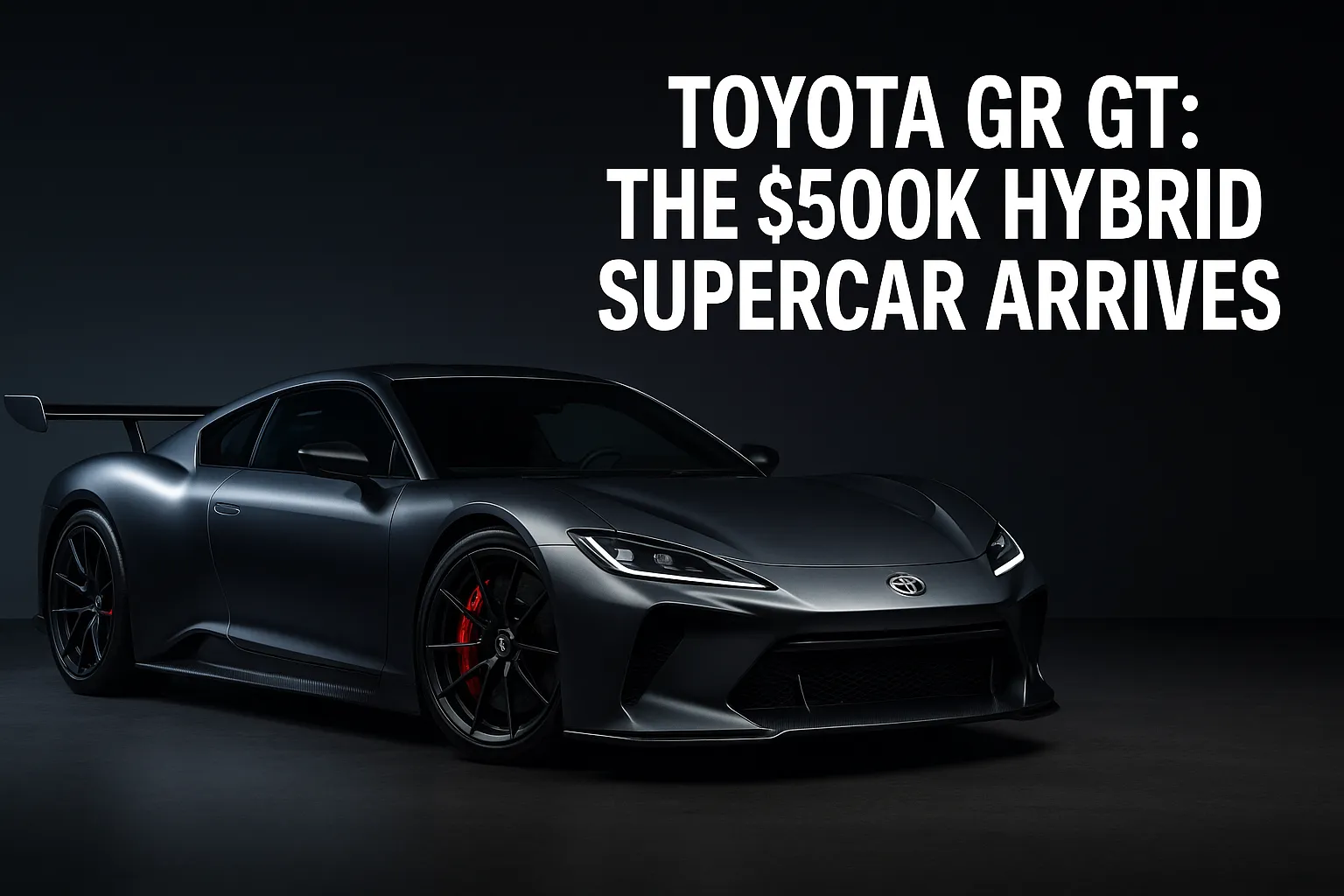
Toyota GR GT: The $500,000 Hybrid Supercar That Redefines Gazoo Racing’s Future
Toyota has officially entered the elite supercar world again—this time not as Lexus, not as an experimental limited-run halo project like the LFA, but as a full-fledged flagship under its Gazoo Racing performance brand. The 2027 Toyota GR GT is more than just a car; it is a declaration that Toyota is returning to high-performance dominance at the highest level of engineering, motorsport, and design.
With a hybrid twin-turbo V8, aerospace-grade materials, and a racing-derived chassis, the GR GT positions itself as a technological and emotional successor to the legendary Lexus LFA—but with a new identity shaped entirely around Toyota’s motorsport DNA.
The GR GT is the first true halo supercar from Gazoo Racing, the department responsible for Toyota’s WRC, Le Mans, and Nürburgring race cars. And with an estimated price around $500,000, Toyota is revealing a machine aimed squarely at the world’s most exclusive supercars.
A New Chapter for Toyota GR: The Dawn of a Supercar Era
Toyota has evolved dramatically in the last decade—from a conservative, reliability-focused automaker to a brand infused with motorsport passion. Under Akio Toyoda’s leadership and his performance persona “Morizo,” the company made driving excitement a priority.
The GR brand began with:
- GR Yaris
- GR Corolla
- GR Supra
- GR86
But none of these represented the ultimate expression of Toyota engineering.
That role now belongs to the GR GT, a supercar developed from the ground up with a driver-first philosophy. Toyota clearly intends this car to be a spiritual heir to the Lexus LFA, but with Gazoo Racing’s raw performance identity.
As Akio Toyoda stated during the premiere:
“Cars should be fun. Cars should make people excited. That is why GR exists.”
The GR GT is exactly that.
A Hybrid Twin-Turbo V8: The Beating Heart of the GR GT
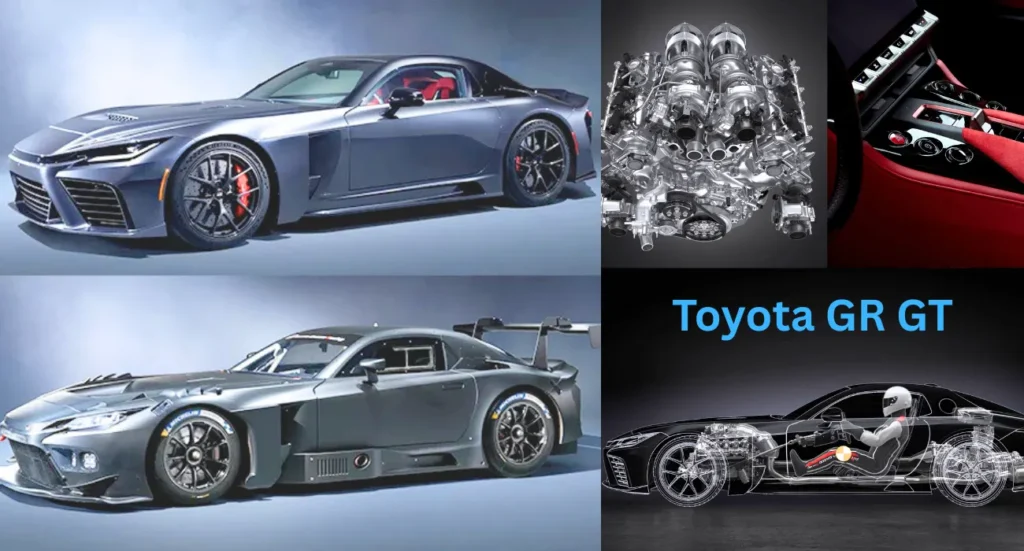
Under the long, low hood sits Toyota’s most ambitious performance engine of the modern era:
Engine Highlights:
- Twin-turbocharged 4.0-liter V8
- Dry-sump lubrication for motorsport-grade oil control
- Direct + indirect fuel injection
- Hybrid electric boost system
While Toyota hasn’t officially confirmed horsepower, insider estimates place output well above 800 hp, putting it in hypercar territory.
This makes the GR GT Toyota’s most powerful road car ever produced.
The hybrid system is not for fuel economy—it is for instantaneous torque, sharper throttle response, and a motorsport-style power delivery.
Aerospace Materials Everywhere: Lighter, Stronger, Faster
The GR GT features an extreme lightweight body structure engineered for maximum rigidity and aerodynamic efficiency.
Materials Breakdown:
- Carbon Fiber:
- Hood
- Roof
- Rear bulkhead
- Aluminum:
- Fenders
- Doors
- Structural components
This combination gives the GR GT:
- A low center of gravity
- Exceptional torsional rigidity
- Race-ready weight reduction
Toyota is clearly applying engineering lessons learned from its Le Mans–winning GR010 Hybrid race car.
Design: Sculpted by the Wind, Built for Speed
From every angle, the GR GT looks like nothing Toyota has ever produced before.
Exterior Highlights:
- Low-slung supercar stance
- Wide fenders for racing grip
- Quad exhaust tips
- Full-width LED taillight
- Aerodynamic “pass-throughs” behind the front wheels
- Massive side intakes for V8 cooling
Toyota says aerodynamics were central to the GR GT’s development—and it shows. Every line is aggressive, functional, and rooted in motorsport.
This is not a luxury sculpture like the Lexus LFA.
This is a weapon built for the track.
Interior: Driver-First Minimalism, Lexus-Level Quality
Despite being sold through Lexus dealerships, the interior of the GR GT remains pure GR.
Interior Style:
- Red leather performance seats
- Slim, fighter-jet digital displays
- Driver-centric cockpit layout
- Physical buttons for essential functions (no distracting screens)
- A compact steering wheel inspired by GT racing
The cabin is tight and focused—exactly how a supercar should feel. Toyota intentionally avoided luxury overload; instead, they aimed for precision and clarity.
It’s premium, but purpose-built.
GR GT3: The Race Car Born Alongside the Supercar
Toyota did not develop the GR GT in isolation. Alongside it, engineers created the GR GT3, a full FIA-sanctioned GT3 racing machine designed to compete globally.
This car is not merely a conversion of the road model—it’s a purpose-built competitor engineered with the same principles:
GR GT3 Core Elements:
- Low center of gravity
- All-aluminum frame
- High rigidity
- Aerodynamic dominance
GR GT3 Specs:
- Drivetrain: RWD
- Engine: Twin-turbo V8
- Displacement: 4.0L
- Length: 4785 mm
- Width: 2050 mm
- Wheelbase: 2725 mm
This is Toyota’s boldest attempt yet to dominate GT3 racing—a class filled with machines from Porsche, Ferrari, Lamborghini, and Mercedes-AMG.
The GR GT3 will put Toyota on the grid among the world’s greatest racing manufacturers.
Premiere Event: Toyota Showcases Its Future
Toyota announced the GR GT and GR GT3 together during a global livestream event on December 5, 2025. Akio Toyoda and Chief Branding Officer Simon Humphries highlighted the company’s vision for emotional, driver-centric performance cars.
Humphries described it as:
“A new generation of sports models shaped by Toyota’s philosophy of continuous renewal.”
This aligns with Toyota’s “Shikinen Sengu” tradition—the ceremonial rebuilding that passes craftsmanship to the next generation.
The GR GT embodies this spirit.
How the GR GT Compares to the Lexus LFA

| Feature | Lexus LFA | Toyota GR GT |
|---|---|---|
| Engine | 4.8L V10 | Twin-Turbo Hybrid V8 |
| Power | 552 hp | 800+ hp expected |
| Price | $375,000 | ~$500,000 |
| Sound | Legendary V10 scream | Hybrid-V8 with electric punch |
| Focus | Emotional performance | Motorsport-first engineering |
| Production | 500 units | TBD |
The GR GT is not a successor—it’s an evolution.
Where the LFA aimed for art, the GR GT aims for domination.
Tires, Grip, and Track Dominance
Toyota fitted the GR GT with Michelin Pilot Sport Cup 2 tires:
- Front: 265/35ZR-20
- Rear: 325/30ZR-20
This setup screams performance:
- Massive rear contact patch
- Uncompromising track grip
- Perfect synergy with the hybrid V8
Combined with race-derived suspension, the GR GT is built to destroy lap times.
Price: Around $500,000 — Is It Worth It?
Toyota has not finalized pricing, but sources estimate:
Expected GR GT Price: ~$500,000
At first glance, this appears steep—but consider the competition:
- Ferrari SF90 Stradale: $524,000
- Lamborghini Revuelto: $608,000
- McLaren Artura: $237,000 (not in same class)
- Aston Martin Valhalla: $800,000
Given the GR GT’s hybrid V8 performance and carbon construction, Toyota is playing in the hypercar-lite category.
And enthusiasts are already calling it:
“The modern spiritual successor to the Lexus LFA.”
Conclusion: Toyota’s Boldest Supercar Ever
The 2027 Toyota GR GT is more than a car—it is a statement.
A statement that Toyota is no longer just a manufacturer of reliable everyday machines.
A statement that Gazoo Racing is rising to challenge Ferrari, Lamborghini, McLaren, and Porsche.
A statement that motorsport engineering is the core of Toyota’s future.
With the GR GT, Toyota has:
- Created a flagship supercar
- Developed a competitive GT3 machine
- Introduced a new performance era
- Reaffirmed its global racing identity
The GR GT is not just a vehicle—
it is Toyota’s declaration of performance leadership for the next decade.