
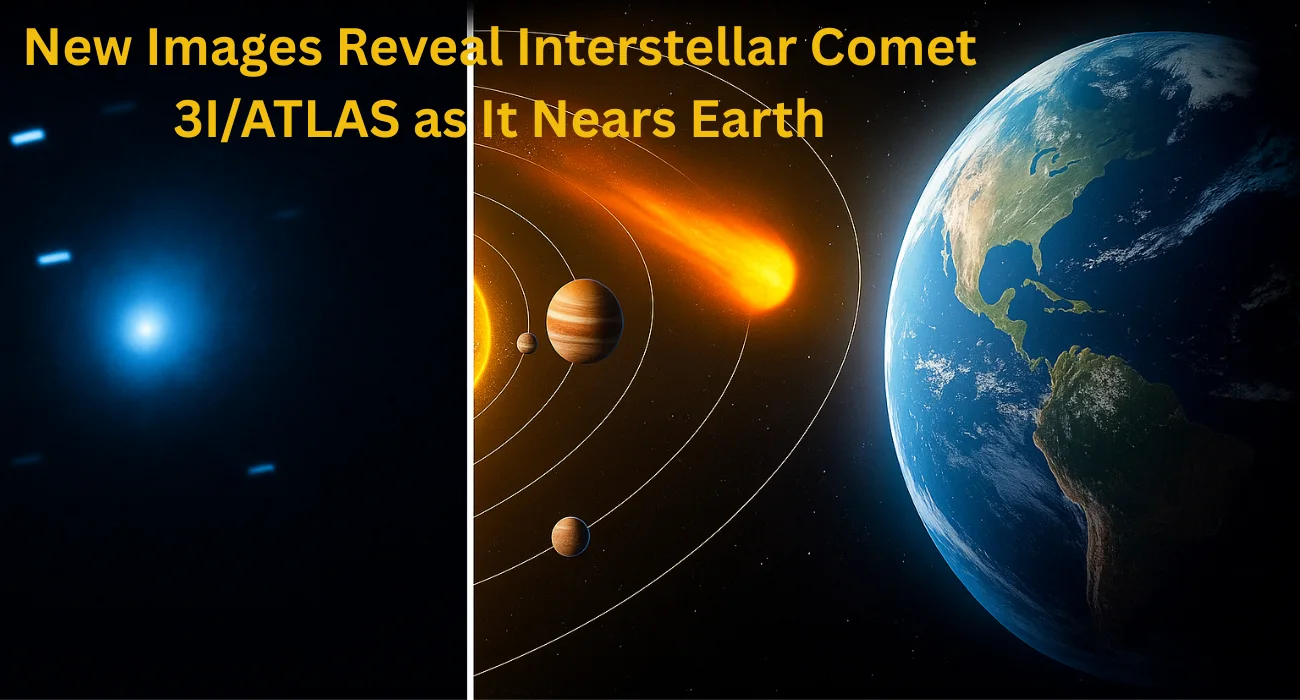
New Images Reveal Interstellar Comet 3I/ATLAS as It Nears Earth — A Rare Visitor Captured by Hubble and ESA’s JUICE Mission
In a year filled with astronomical surprises, a once-in-a-lifetime celestial visitor is capturing the world’s attention. Interstellar comet 3I/ATLAS, only the third interstellar object ever detected passing through our solar system, is now making its closest approach to Earth — and the newest images captured by NASA’s Hubble Space Telescope and the European Space Agency’s JUICE spacecraft are nothing short of extraordinary.
This comet is not from here. It did not originate in the Kuiper Belt or the Oort Cloud. Instead, it comes from another star system entirely, drifting across the galaxy before briefly entering our cosmic neighborhood. Scientists estimate it will never return again.
As 3I/ATLAS approaches its closest point to Earth on December 19, 2025, astronomers are racing against time to study its structure, chemistry, and behavior before it vanishes back into interstellar space.
Thanks to new observations from Hubble and ESA’s Jupiter Icy Moons Explorer (JUICE), we now have the clearest insights yet into this rare interstellar traveler.
A Rare Discovery: Only the Third Known Interstellar 3I/ATLAS Object
Interstellar objects are among the most mysterious phenomena in astronomy. Before 3I/ATLAS, only two had ever been confirmed:
- 1I/ʻOumuamua in 2017 — a cigar-shaped object that baffled scientists
- 2I/Borisov in 2019 — the first known interstellar comet
When astronomers detected 3I/ATLAS in July 2025, the scientific community was electrified. Its chemical features, trajectory, and speed revealed it was not gravitationally bound to the Sun. Rather, it was simply passing through, allowing humanity a brief window to study material formed around another star.
Because these objects are exceedingly rare, every observation offers clues to how other planetary systems form — and how they differ from our own.
Hubble Observes 3I/ATLAS — Twice
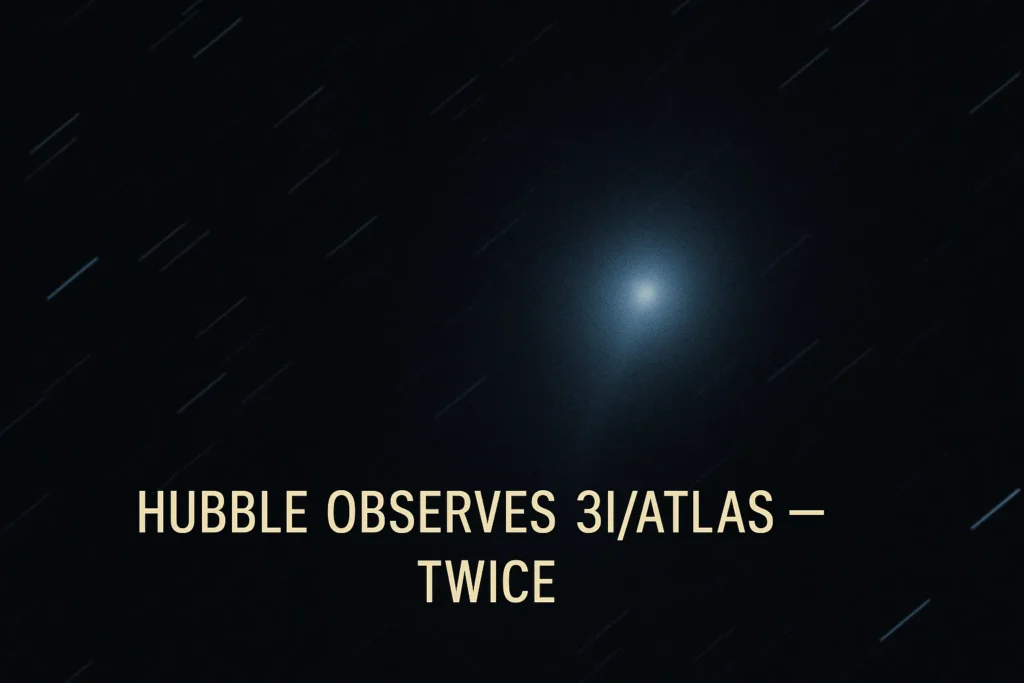
NASA’s Hubble Space Telescope has now observed 3I/ATLAS two times:
- July 21, 2025 — shortly after discovery
- November 30, 2025 — capturing a much clearer view
Using its Wide Field Camera 3, Hubble tracked the comet at a distance of 178 million miles (286 million km) from Earth. As Hubble followed the comet’s movement, background stars streaked across the image as glowing lines — a beautiful reminder of Hubble’s precision.
The Teardrop Coma
Hubble’s first image revealed something fascinating:
A teardrop-shaped cocoon of dust surrounding the comet’s icy nucleus.
This coma shape suggested intense sublimation — gases rapidly evaporating from the comet as sunlight heated it.
The new November images show an even larger, brighter coma. This means the comet became more active as it approached the Sun in October, releasing gases and dust from its nucleus in spectacular fashion.
ESA’s JUICE Mission Captures the Comet from Deep Space
While Hubble observed 3I/ATLAS from Earth’s orbit, ESA’s JUICE mission captured a totally different perspective.
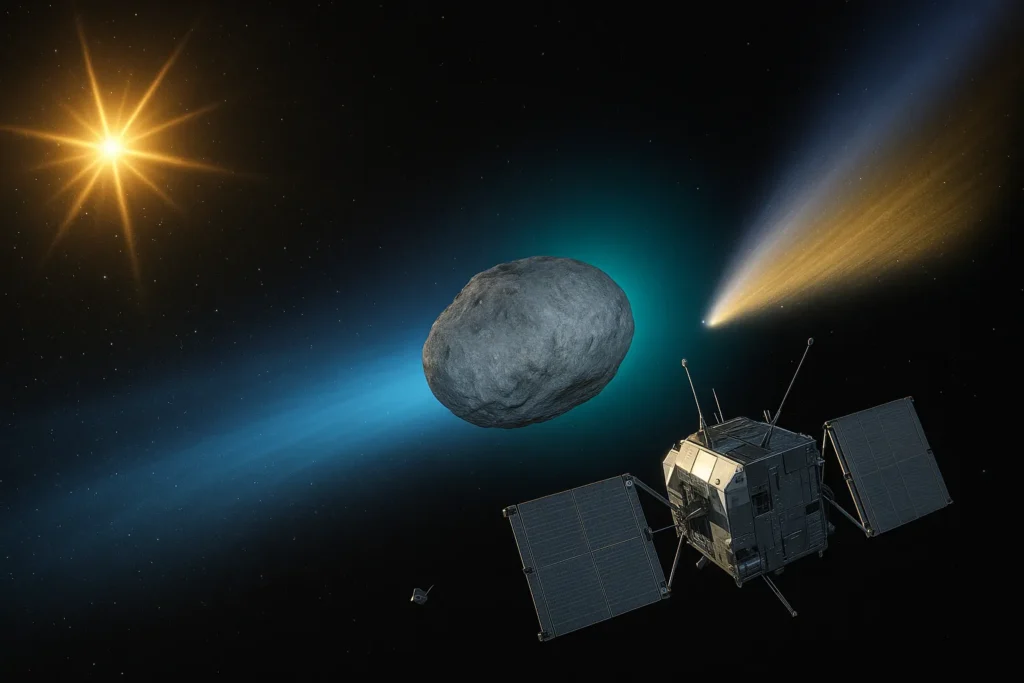
JUICE — launched in 2023 to study Jupiter and its icy moons — was 66 million kilometers (41 million miles) from the comet when it imaged it on November 2, 2025 using its Navigation Camera (NavCam).
The NavCam isn’t even designed for science imaging. Still, the shot surprised mission controllers.
Two Tails Revealed
JUICE’s partial image revealed:
- A glowing coma of sublimated gas
- A plasma tail (electrically charged particles pushed away by solar wind)
- A dust tail (tiny solid particles drifting behind the comet)
These two distinct tails match those of comets native to our solar system — an intriguing parallel that suggests some processes of comet evolution may be universal across the galaxy.
Because JUICE is currently using its main antenna as a heat shield, most of its comet data will not arrive until February 18–20, 2026. Those datasets will include:
- High-resolution images from the JANUS camera
- Spectral data from MAJIS and UVS
- Composition data from SWI
- Particle data from PEP
These will help scientists reconstruct what 3I/ATLAS is made of — offering direct samples of chemistry from another star system.
Why Interstellar Comets Are So Important
Comets from our solar system already serve as time capsules, containing primitive material from the earliest days of the Sun’s formation.
But interstellar comets?
They contain alien chemistry — material shaped by stars, radiation, temperatures, and processes outside our solar system. Studying them gives astronomers a unique opportunity:
1. Understanding other star systems
Each interstellar comet carries signatures of its home system’s:
- Chemical composition
- Temperature history
- Stellar radiation exposure
- Dust distribution
These reveal how planets and stars form elsewhere in the galaxy.
2. Comparing solar system formation
Do other systems produce similar cometary materials?
Or are they wildly different?
3. Tracing galactic pathways
3I/ATLAS’s trajectory may help scientists understand:
- Its origin star
- Its travel duration
- How gravitational interactions fling comets into interstellar space
4. Preparations for future interstellar missions
As more such objects are discovered, space agencies hope to one day intercept — and maybe even sample — an interstellar visitor.
How Close Will 3I/ATLAS Come to Earth?
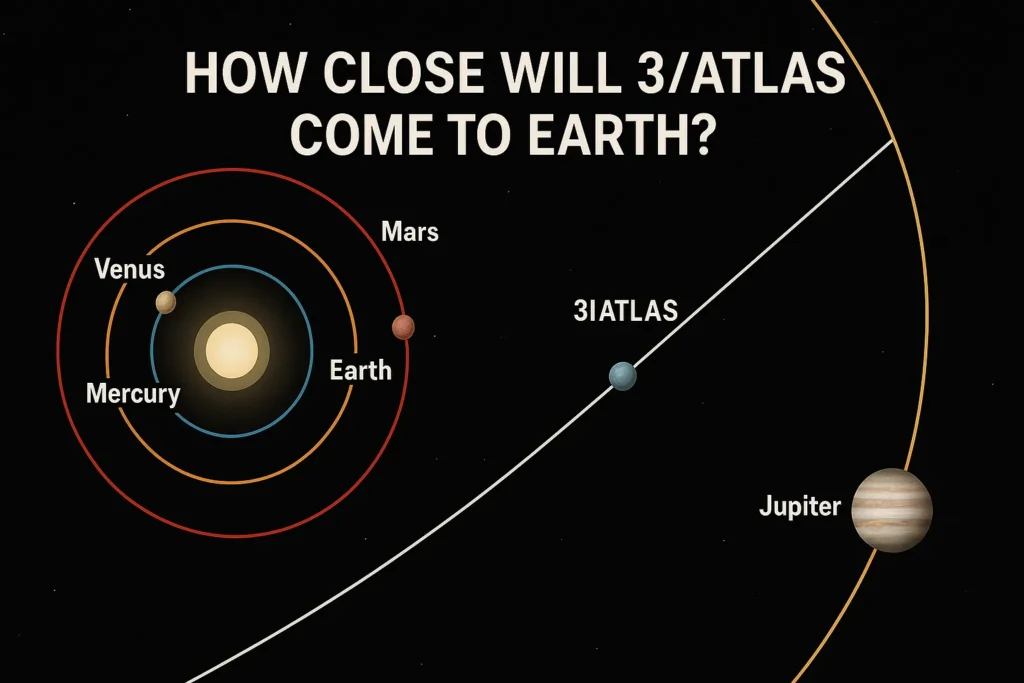
The comet will pass 167 million miles (270 million kilometers) from Earth on:
December 19, 2025
Important note:
It poses no danger.
It will be on the opposite side of the Sun during closest approach.
Still, telescopes across the world and in space will be watching, collecting as much data as possible before the comet disappears forever.
What Happens Next?
3I/ATLAS will remain visible to major observatories for a few more months. Eventually, it will fade from view and leave our solar system — never to return.
The most exciting phase is still ahead:
- JUICE will send high-quality images and spectral data in February 2026
- Scientists will analyze gases released near the comet’s closest solar pass
- Hubble may attempt a third observational run
These combined datasets will build the most complete picture ever made of an interstellar comet.
Final Thoughts: A Visitor From Beyond the Sun
Interstellar comet 3I/ATLAS is more than a scientific curiosity — it is a messenger from another part of the galaxy, offering a fleeting chance to study material formed under completely different cosmic conditions.
With Hubble, JUICE, and NASA’s fleet of spacecraft working together, we are witnessing one of the most coordinated observational campaigns ever executed for an interstellar object.
As 3I/ATLAS speeds toward the edge of our solar system, it leaves behind invaluable clues about the history, chemistry, and dynamics of distant star systems.
For astronomers, this is a rare and precious gift — a reminder of how vast, mysterious, and interconnected our galaxy truly is.