


Stock Market Today: Why Stocks Are Down, Tech Is Crashing, and What Comes Next
Introduction: A Sudden Shift in Market Mood
The stock market today is sending a clear signal: fear has returned to Wall Street. After months of optimism driven by artificial intelligence, election momentum, and strong earnings expectations, U.S. stocks are now sliding sharply. The S&P 500, Nasdaq, and Dow Jones are all under pressure as investors digest disappointing earnings, weak labor data, falling crypto prices, and rising uncertainty around the future of Big Tech.
This article explains why stocks are down today, what’s driving the sell-off, and what investors should realistically expect next.
Markets at a Glance: What’s Falling
U.S. stock futures and indexes are pointing lower across the board. The tech-heavy Nasdaq is leading the decline, followed closely by the S&P 500, while the Dow Jones is also sliding. Exchange-traded funds like QQQ, which track major technology stocks, have fallen sharply as investors exit high-growth names.

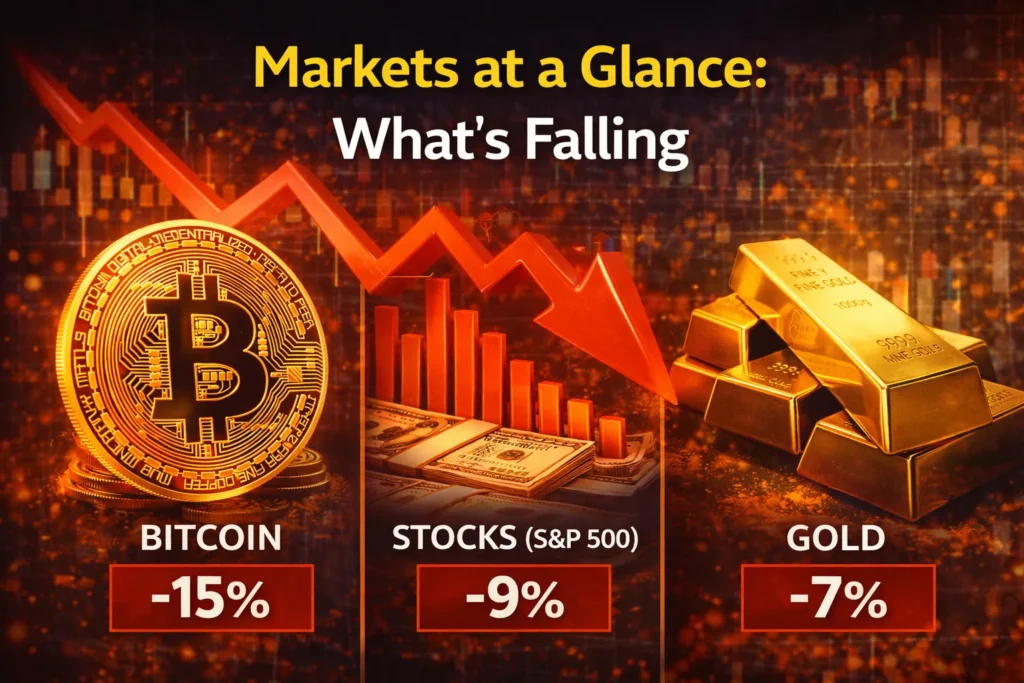
The selling pressure is broad, affecting stocks, crypto, and even precious metals.
Amazon’s Earnings Shock Sparked the Sell-Off
One of the biggest triggers behind today’s market drop is Amazon. The tech giant’s earnings disappointed Wall Street after it forecast weaker-than-expected operating income and revealed massive spending plans for artificial intelligence infrastructure. Amazon shares plunged more than 10% in early trading, sending shockwaves across the entire tech sector.
Because Amazon is a heavyweight in the Nasdaq and S&P 500, its decline alone dragged the broader market lower.
Why Amazon’s Results Spooked Investors
Investors are increasingly worried that Big Tech’s aggressive AI spending may not deliver profits quickly enough. Amazon’s plan to invest over $200 billion in coming years raised concerns about shrinking margins, slower growth, and rising capital costs. Wall Street is now questioning whether the AI boom is turning into an earnings burden rather than a growth engine.
This fear is spreading beyond Amazon to Microsoft, Alphabet, and other mega-cap tech firms.
The Nasdaq Is Officially in a Tech Rout
The Nasdaq has now suffered its worst multi-day slide since April, falling roughly 6% from its recent highs. Software and cloud stocks have been hit particularly hard as new AI tools raise questions about future demand for traditional software services. Investors are no longer buying growth at any price — they are demanding profitability.
This shift marks a major change in market psychology.
QQQ Stock Reflects Tech Sector Pain
The QQQ ETF, which tracks Nasdaq-100 stocks, has dropped sharply as technology names dominate the sell-off. Because QQQ is heavily weighted toward mega-cap tech, losses in Amazon, Microsoft, and other leaders are amplified. Retail investors who piled into QQQ during the AI rally are now experiencing rapid drawdowns.
This highlights how concentrated tech exposure can magnify both gains and losses.
Why the S&P 500 Is Sliding
More than 60% of stocks in the S&P 500 closed lower, showing that the sell-off is not limited to a few companies. While technology is leading the decline, weakness has spread to consumer discretionary, industrials, and financials. Investors are rotating away from risk as uncertainty grows.
When the majority of stocks fall together, it signals deeper market stress.
Dow Jones Falls as Growth Fears Rise
The Dow Jones Industrial Average dropped hundreds of points as investors reassessed economic growth prospects. Stocks tied to consumer spending and manufacturing are under pressure as weaker labor data raises concerns about slowing demand. Even traditionally defensive names have failed to provide shelter.
This suggests fear is outweighing fundamentals in the short term.
Weak Labor Data Is Shaking Confidence
Economic data has added fuel to the market decline. Job openings fell to their lowest level since 2020, while layoff announcements surged to levels not seen since the financial crisis. These reports suggest the U.S. labor market may be weakening faster than expected.
For investors, a slowing job market raises the risk of reduced consumer spending and lower corporate profits.
Delayed Jobs Report Adds to Uncertainty
The January nonfarm payrolls report has been delayed due to the federal government shutdown, leaving investors without a key economic signal. Markets hate uncertainty, and the absence of clear labor data is making traders more cautious.
Until clarity returns, volatility is likely to remain elevated.
Fear Gauge Signals Market Stress
Wall Street’s volatility index, known as the VIX, surged above 20 — a level associated with heightened fear. The Fear & Greed Index has firmly entered “fear” territory, reflecting growing investor anxiety. Historically, such readings often coincide with sharp market swings.
Fear can drive markets lower even when fundamentals remain mixed.
Bitcoin’s Collapse Is Dragging Stocks Lower
The sell-off isn’t limited to equities. Bitcoin has plunged nearly 50% from its October highs, falling below $63,000. Crypto-related stocks and companies holding Bitcoin on their balance sheets have suffered steep losses, adding pressure to broader markets.
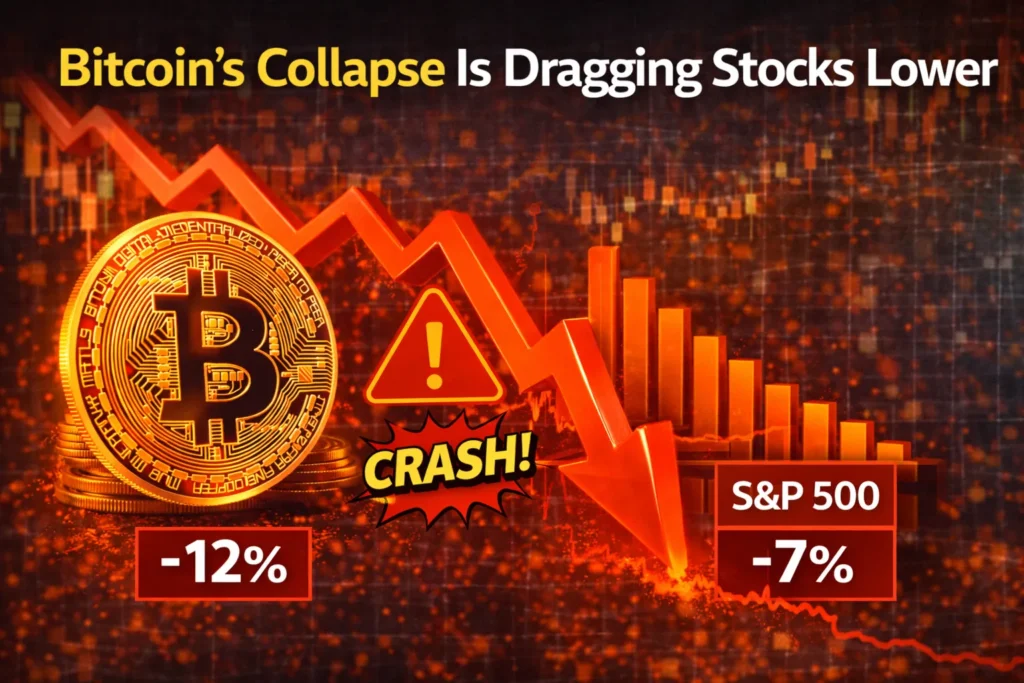
When crypto crashes, it often signals risk aversion across asset classes.
Why Bitcoin Stocks Are Falling
Companies exposed to Bitcoin and digital assets are underperforming as prices collapse. Losses in crypto-focused firms are spilling into equity markets, reinforcing the risk-off mood. Investors are questioning the sustainability of crypto-linked business models in a tightening financial environment.
This adds another layer of stress to already fragile markets.
AI Anxiety Is Replacing AI Euphoria
Just months ago, AI was the market’s biggest driver. Now, fear has replaced optimism. Investors are worried that new AI tools could disrupt traditional software revenue models, reducing long-term profitability. Instead of celebrating innovation, markets are focusing on potential downside risks.
This shift is one of the biggest reasons tech stocks are underperforming.
Rising Costs and Falling Margins
Higher interest rates, rising wages, and massive capital expenditures are squeezing corporate margins. Even companies with strong revenue growth are seeing profits come under pressure. Wall Street is no longer rewarding growth without efficiency.
This environment favors caution over speculation.
Why Stocks Are Down Today in Simple Terms
Stocks Markets are down today because investors are nervous. Weak earnings guidance, slowing job growth, collapsing crypto prices, and uncertainty around AI profitability have combined into a perfect storm. When confidence fades, selling accelerates.
Markets move on expectations, not just current results.
Is This the Start of a Bigger Market Correction?
Some analysts believe the market is entering a broader correction after an extended rally. Others see this as a healthy reset following excessive speculation. While it’s too early to call a bear market, the risk of further downside remains real.
Much depends on upcoming earnings and economic data.
How Long Could the Sell-Off Last?
Market pullbacks driven by fear can last weeks or months. If labor data continues to weaken and earnings disappoint, stocks could remain under pressure. However, strong results or supportive policy signals could quickly change sentiment.
Volatility is likely to persist in the near term.
What Long-Term Investors Should Consider
Long-term investors should focus on fundamentals rather than short-term market swings. Corrections often create opportunities to buy high-quality companies at better valuations. However, patience and risk management are essential.

Trying to time the bottom is rarely successful.
Should Investors Panic?
History shows that panic selling often leads to regret. While the current environment is challenging, markets have recovered from similar periods of fear before. Staying disciplined matters more than reacting emotionally.
Fear is temporary; strategy is lasting.
What Could Stabilize the Market?
Markets could stabilize if earnings improve, labor data shows resilience, or inflation eases enough to support interest-rate cuts. Clear guidance from companies and policymakers would help restore confidence.
Until then, caution dominates.
How This Sell-Off Compares to Past Market Drops
Unlike sudden crashes driven by single events, this decline is rooted in multiple concerns: growth, technology disruption, and macro uncertainty. That makes it more complex — and potentially longer-lasting.
Still, history suggests markets eventually adapt.
Key Takeaways for Investors
Today’s market drop is a reminder that bull markets don’t move in straight lines. Excess optimism around AI, crypto, and tech spending is being reassessed. Investors are shifting from hope to hard analysis.
This transition is painful but necessary.
Conclusion: Why the Market Is Down Today
The stock market is down today because confidence has cracked. Amazon’s earnings shock, AI fears, weak labor data, and Bitcoin’s collapse have combined to push investors into defensive mode. While the near-term outlook is uncertain, markets are doing what they always do — repricing risk.
For investors, understanding why markets fall is more important than predicting when they will rise again.