


NASA’s Habitable Planet Search Explained — Can Humans Live There? (2025 Guide)
For decades, humanity has wondered if we are alone in the universe. Today, NASA is closer than ever to answering that question. With advanced telescopes, new data from deep space, and groundbreaking analytic tools powered by AI, the search for habitable worlds — planets that could potentially support human life — has become one of NASA’s top scientific priorities.
In 2025, this mission has accelerated dramatically, revealing dozens of new “Earth-like” candidates, identifying promising star systems, and raising a new question people are asking everywhere:
Could humans eventually live on one of these planets?
This complete guide breaks down NASA’s modern habitable planet search, the technology behind it, the worlds discovered so far, and whether any of them could truly support human life.
What Does “Habitable Planet” Actually Mean?
NASA does not label a planet “habitable” only because it looks like Earth. Instead, scientists use strict criteria:
NASA’s 3 Core Requirements
1. The planet must be in the “Goldilocks Zone.”
This is a region around a star where temperatures allow liquid water — not too hot, not too cold.
2. The planet must have an atmosphere.
An atmosphere stabilizes temperature, protects from radiation, and may contain oxygen, nitrogen, or other life-sustaining gases.
3. The planet must be rocky, not gaseous.
Humans cannot live on a gas giant like Jupiter. Rocky planets with solid surfaces are essential.
Other helpful features include:
- A magnetic field
- Surface water
- Stable climate
- Favorable star type (not too hot or violent)
Even with these requirements, a planet being habitable does not automatically mean humans could live there without major technology.
How NASA Finds Habitable Planets in 2025
NASA uses multiple space telescopes and detection techniques to locate and analyze exoplanets.
A. Transit Method — The Most Successful Technique
When a planet passes in front of its star, it blocks a tiny amount of light. NASA measures this dip to:
- Detect the planet
- Estimate its size
- Determine its orbital period
This method discovered thousands of planets, including most “Earth-like” ones.
B. Radial Velocity — Measuring Star Wobbles
A planet’s gravity causes its star to wobble slightly. NASA measures this motion to determine:
- Planet mass
- Orbital speed
- Distance from star
C. Direct Imaging — Rare, But Powerful
NASA now uses advanced telescopes like JWST to capture actual images of distant planets.
This method helps analyze:
- Planet atmospheres
- Heat signatures
- Potential weather patterns
NASA’s Main Missions in the Habitable Planet Search

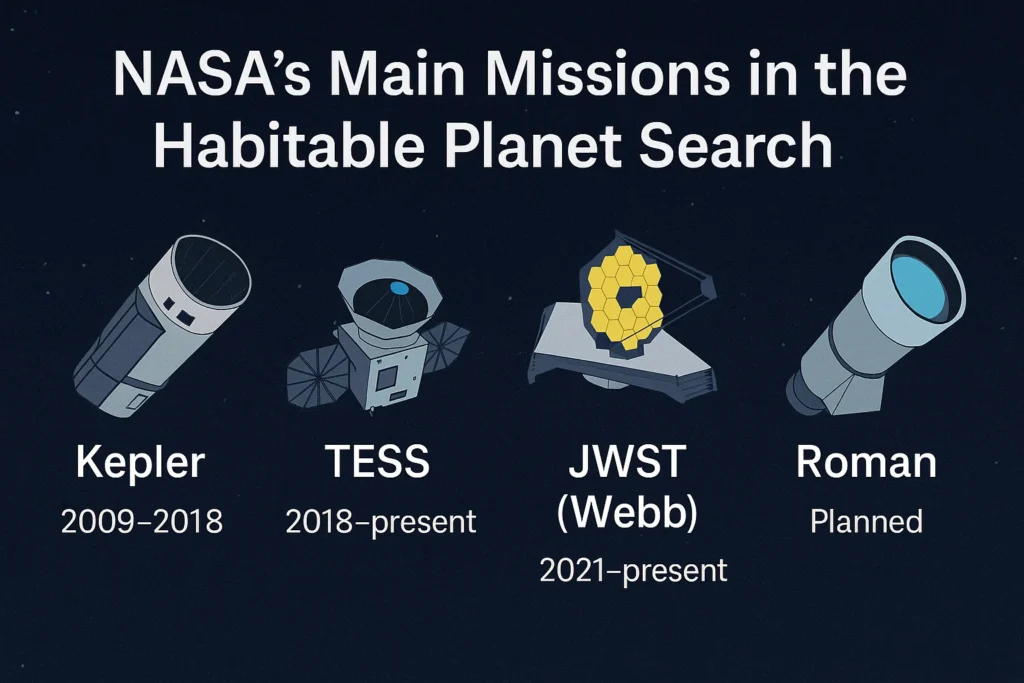
1. Kepler Space Telescope
Launched: 2009
Status: Retired
Kepler revolutionized astronomy by discovering over 2,600 exoplanets and identifying the first truly Earth-like candidates.
2. TESS (Transiting Exoplanet Survey Satellite)
Launched: 2018
Status: Active in 2025
TESS scans almost the entire sky, finding planets around the nearest stars — most promising for future travel or robotic exploration.
3. JWST (James Webb Space Telescope)
Launched: 2021
Status: The most powerful telescope ever built
JWST can analyze:
- Planet atmospheres
- Heat signatures
- Potential biomarkers like methane or carbon dioxide
It has already detected possible signs of habitability in several exoplanets.
4. Roman Space Telescope (Launching Soon)
Expected Launch: 2027
NASA expects Roman to detect tens of thousands of planets, including many Earth-sized ones.
The Most Promising Habitable Worlds Found So Far

NASA has identified several worlds with high potential for habitability.
Kepler-452b — The “Older Cousin” of Earth
- 60% larger than Earth
- Orbit similar to Earth’s
- In the habitable zone
Its age suggests life could have had billions of years to develop.
Kepler-186f — First Earth-Sized Planet in the Right Zone
- Almost identical to Earth in size
- Located 500 light-years away
- Receives similar energy from its star
TRAPPIST-1 System — The Best Chance for Human Futurer
Seven Earth-sized planets orbit this ultra-cool dwarf star.
NASA believes:
- At least three may host liquid water
- Some have atmospheres
- They’re only 40 light-years away
This is NASA’s top candidate for future exploration.
Proxima Centauri b — The Closest Potentially Habitable World
- Only 4.2 light-years from Earth
- Located in the habitable zone
- Rocky and Earth-sized
However, the star emits powerful solar flares, which may strip the atmosphere.
What Would Humans Need to Survive on These Planets?
Even if a planet is “habitable,” humans cannot simply step out of a spaceship and start living. We require:
A breathable atmosphere
Oxygen near 21%.
Protection from radiation
Strong magnetic field or artificial shielding.
Stable temperatures
Extreme heat or cold would need habitat domes.
Liquid water
Essential for survival and agriculture.
Transport systems
Fast spacecraft using nuclear fusion or advanced propulsion.
Most planets fail at least one major requirement, meaning human life would require advanced colonization technology.
The Biggest Challenges of Living on a Habitable Planet
A. Distance
Even the closest planets take:
- 4 years at light-speed
- 75,000 years with current spacecraft
NASA is researching:
- Nuclear propulsion
- Ion drives
- Artificial wormholes
- Solar sails
B. Atmosphere Composition
Many planets contain:
- Too much CO₂
- Toxic gases
- Lack of oxygen
Humans would need:
- Oxygen generators
- Sealed habitats
- Terraforming over centuries
C. Gravity Differences
Too much gravity: organ failure
Too little gravity: muscle and bone loss
D. Alien Microorganisms
Unknown microbes could be dangerous.
NASA requires strict planetary protection protocols.
Is NASA Trying to Find Planets for Colonization?
NASA’s official priority is scientific discovery, not colonization.
However…
NASA’s long-term goals include:
- Finding safe planets for future generations
- Identifying potential resources
- Understanding Earth’s future by studying other worlds
Private companies like SpaceX are pushing harder toward colonization.
Did NASA Find Signs of Life Yet?
As of 2025:
- No confirmed life has been found
- But several planets show possible biosignatures
This includes:
- Methane in atmospheres
- Oxygen fluctuations
- Seasonal chemical changes
NASA says the next 10 years could reveal the first confirmed life signs.
Will Humans Ever Live on Another Planet?
Experts believe:
YES — but not soon.
Humans may colonize planets or moons by:
- 2060–2100: Mars and Moon bases
- 2150+: First interstellar robotic probes
- 2300+: Human settlements on exoplanets
Artificial habitats (space stations, asteroid bases) may be easier than living on planets.
Final Answer — Can Humans Live on NASA’s Habitable Planets?
Not yet — but we are closer than ever.
NASA’s discoveries show:
- Earth-like planets are common
- Many have water, atmospheres, and stable climates
- Some could support life now or in the future
But humans need:
- Better spacecraft
- Safer habitats
- Advanced terraforming
- Long-term survival systems
Human colonization of a habitable planet is no longer science fiction — it is future science.
Conclusion
NASA’s search for habitable planets is one of the most significant scientific missions in human history. With the help of Kepler, TESS, JWST, and future telescopes, NASA has already discovered worlds that resemble Earth more closely than anything imagined decades ago.