
The Power Behind AI’s Rise
Artificial Intelligence (AI) has taken the world by storm since 2022, driving innovation in everything from chatbots to robotics.
At the center of this digital revolution is Nvidia, a company whose chips power nearly every major AI system today.
Nvidia’s growth has been breathtaking. In late October 2025, its market value crossed $5 trillion, and it’s expected to make more profit this year than Intel and AMD combined.
But the big question remains: Can Nvidia keep its lead in the fast-changing world of AI?
Summary
Nvidia dominates the AI hardware industry through its advanced Blackwell and Hopper chips, which power massive AI data centers.
The company’s speed of innovation, strong ecosystem, and bold leadership under Jensen Huang have kept it ahead of rivals.
However, competition, global politics, and AI over-investment risks could challenge its reign.
What Makes Nvidia the King of AI Chips?
Nvidia didn’t start as an AI company. It was founded in 1993 to make graphics processing units (GPUs) — chips that make video games look realistic with shadows, reflections, and movement.
In the 2000s, Nvidia engineers realized that these GPUs could also be used for other heavy computing tasks, including scientific and AI research.
This discovery changed everything. GPUs could process thousands of calculations simultaneously, making them ideal for training large AI models.
Today, Nvidia controls around 90% of the data center AI chip market, according to IDC Research (2025) — a level of dominance rarely seen in tech.
What Are Nvidia’s Most Popular AI Chips?
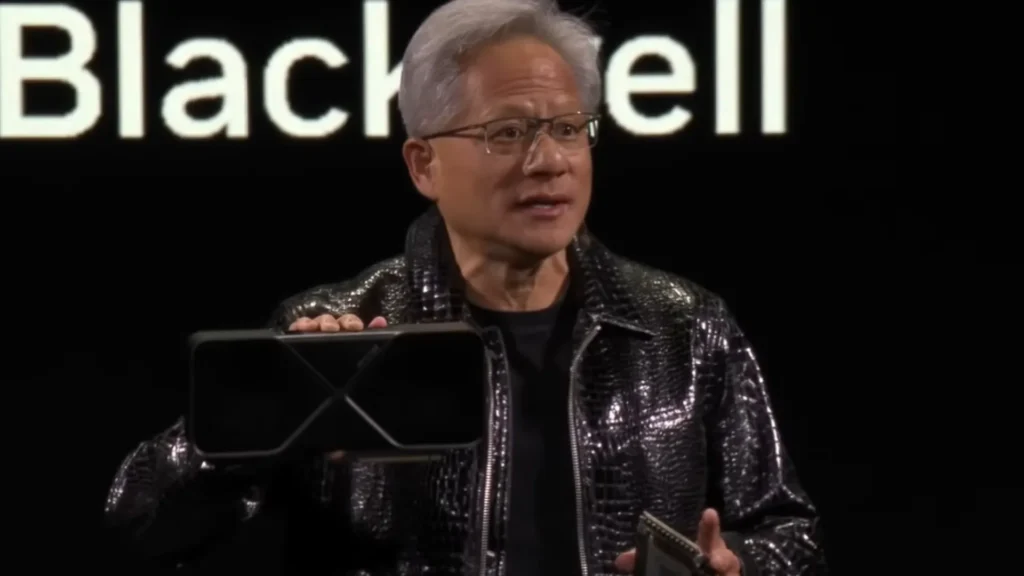
Nvidia’s current stars are the Hopper and Blackwell series — named after pioneering computer scientists Grace Hopper and David Blackwell.
- Hopper (H100) was the backbone of AI systems in 2023–2024.
- Blackwell (B200), released in 2025, delivers 2.5× the performance in AI training and inference.
The GB200 Superchip combines:
- Two Blackwell GPUs, for AI computing power
- One Grace CPU, for general processing tasks
Together, they act like a single brain, capable of processing massive data volumes at incredible speed.
How Do Nvidia Chips Power AI Systems?
AI models like ChatGPT, Gemini, and Claude learn from massive datasets. This process, called training, involves billions of calculations — exactly what GPUs are good at.
Once trained, these models need to “run” efficiently to answer questions or generate text — this stage is called inference.
Nvidia’s chips handle both phases using advanced technologies like NVLink (for connecting multiple chips) and CUDA, a software platform that lets developers optimize their code for Nvidia hardware.
This combination of hardware + software makes Nvidia nearly impossible to replace quickly.
Who Are Nvidia’s Biggest Competitors?
Nvidia faces two main rivals — AMD and Intel — plus a few big cloud companies designing their own chips.
| Company | Focus Area | Notable Product | 2025 Market Status |
|---|---|---|---|
| AMD | AI GPUs | Instinct MI450 (launching 2026) | Growing fast with deals from OpenAI and Oracle |
| Intel | CPUs & AI accelerators | Gaudi series (limited release) | Partnering with Nvidia while rebuilding |
| Google, Amazon, Microsoft | In-house AI chips | TPU, Trainium, Maia | Reducing reliance on Nvidia |
AMD has gained credibility with its OpenAI deal, while Intel, once the chip king, is now collaborating with Nvidia instead of competing head-on.
Still, no one has matched Nvidia’s ecosystem, software tools, and production scale.
How Does Nvidia Stay Ahead of the Competition?
Nvidia’s secret isn’t just powerful chips — it’s the entire package:
- Rapid Innovation
Nvidia releases a new flagship chip every year, keeping rivals in constant catch-up mode. - Software Ecosystem
The CUDA platform and AI frameworks built by Nvidia make it easier for developers and companies to use its chips efficiently. - Customer Support & Clusters
Nvidia helps major clients like Microsoft, Amazon, and Meta build massive AI data centers — selling not just chips but complete systems. - Aggressive Marketing
CEO Jensen Huang is known for his public appearances and partnerships worldwide. His message: “AI is the new industrial revolution.”
Is AI Demand Still Rising?
Absolutely.
Even older Nvidia chips are selling out as tech giants race to build AI data centers.
In October 2025, Nvidia projected $500 billion in data center revenue over the next five quarters — numbers that shocked even optimistic analysts.
In just one week, its market value rose by $400 billion after the announcement.
Major customers like Microsoft, Google, Amazon, Meta, and OpenAI are each spending hundreds of billions on AI infrastructure.
Still, some industry experts warn that this level of investment might be too much too soon, with limited short-term returns.
Geopolitical Challenges: The China Problem
Nvidia’s growth isn’t just about tech — politics play a big role.
The US government has restricted Nvidia from selling its most powerful chips (like H100 and B200) to China, citing national security concerns.
China is the world’s largest chip market, so the ban hit Nvidia hard.
In April 2025, Nvidia took a $5.5 billion loss due to unsold chips made for China (the “H20” model).
Later, the US eased the ban — but China retaliated, asking local companies to avoid Nvidia products.
Jensen Huang is personally lobbying President Donald Trump’s administration, arguing that:
“If America doesn’t supply AI chips, others will — and that will hurt US leadership.”
So far, negotiations haven’t resulted in any lasting agreement.
The Future: Can Nvidia Keep Its Crown?
Nvidia’s dominance is built on three pillars:
- Innovation speed
- Software advantage
- Massive ecosystem of partners
But there are real risks:
- Rivals like AMD are gaining ground
- Geopolitical tension could block major markets
- AI spending might cool if returns disappoint
Still, Jensen Huang seems unfazed. Nvidia is committed to launching a new top chip every year — a pace unmatched in tech history.
For now, Nvidia remains the undisputed king of AI chips.
Summary
| Key Point | Insight |
|---|---|
| Market Share | ~90% of AI data center GPUs (IDC, 2025) |
| Flagship Product | Blackwell GB200 Superchip |
| Main Competitors | AMD (Instinct MI450), Intel (Gaudi) |
| Revenue Forecast | $500B from data centers (next 5 quarters) |
| Challenge | US-China trade restrictions |
| CEO Vision | “AI is the new industrial revolution.” |
FAQs
Q1: Why are Nvidia chips important for AI?
Because they can handle billions of calculations at once — perfect for training and running AI systems.
Q2: What’s the difference between Hopper and Blackwell chips?
Blackwell is 2.5× faster and more efficient than Hopper, making it the new AI standard.
Q3: Who are Nvidia’s main customers?
Microsoft, Google, Amazon, Meta, and OpenAI — all using Nvidia chips for their cloud AI services.
Q4: Could Nvidia lose its lead?
Possible — but unlikely soon. Its software and ecosystem create a big competitive moat.
Q5: How much is Nvidia worth?
As of October 2025, around $5 trillion, making it one of the most valuable companies in the world.